top of page
AiTuki — Cortisol-Smart Stress Partner
From niche perimenopause app to broad metabolic-stress platform
TL;DR
AiTuki started as a perimenopause app. Research with 40+ users revealed the real pain was much wider — chronic metabolic stress affecting knowledge workers of any gender or age. I led the product strategy pivot, redesigned the UX from passive tracker to adaptive "Smart Mentor," and built the design system — turning early user validation into a defensible market position and a working funded prototype.
Tools
Figma · Miro · GPT
My Role
Product Designer
Team
12 members
Duration
6 months

Try the Live Demo
About AiTuki
Prototype Demo
Prototype Demo
About AiTuki
The Product

AiTuki is a cortisol-smart wellness app that connects wearable data to personalised, just-in-time micro-interventions — not dashboards, not raw scores. Think of it as a Smart Mentor that reads your stress patterns and surfaces 1–2 small, specific actions daily with a short "why this now" explanation. Built for knowledge workers who are data-rich but action-poor.
The Challenge
A product positioned too narrowly
The original brief was a perimenopause app. While the pain was real, language testing showed it was excluding large segments — men, younger users, anyone with burnout or insomnia — who had the exact same cortisol-driven symptoms.
No training data for the AI
A cortisol-smart AI needs labelled habit data linked to clinical outcomes. That data didn't exist. We had to build the data pipeline from scratch — cohort tracking, doctor annotation, then model training — before the product could work as promised.
Passive trackers were the baseline expectation
Users were conditioned by Fitbit and Apple Health to expect data, not decisions. Designing for action — not just observation — required a fundamentally different mental model and UX pattern.
Research & The Pivot
I ran focus groups and surveys with 40 knowledge workers aged 30–55, most already using wearables. Three findings drove the strategy decision:
37.5%
Immediately volunteered for our Cohort-1 cortisol study; 24 more waitlisted
58%
Would prepay 6 months upfront to avoid 'yet another tracking app'
83%
Willing to pay $5–10/month if the app helped in the moment — not just tracked
THE PIVOT
Perimenopause moved from being the market to being one powerful use case inside a broader cortisol-smart platform. The language shift from "perimenopause" to "metabolic stress" unlocked a market an order of magnitude larger — and users recognised themselves in it immediately.
Process
How we went from messy early research to a clinically-grounded, funded prototype in 6 months.
Discovery — understand before designing
Focus groups, surveys, language-testing with 40 participants. Goal: find the real pain, not just the stated problem. Outcome: the pivot decision.
Data pipeline — build what the AI needs
Enrolled cohort users via Movement.so for 8-week habit tracking across 4 pillars. Partnered with clinicians to annotate patterns. Created the labelled dataset for model training.
Strategy & concept — define what to build
Defined the Smart Mentor concept, MVP scope (cortisol-first), and JITAI interaction model. Wrote the product narrative for both users and investors.
Design & prototype — validate with real users
Led end-to-end UX flows, design system, and motion language. Collaborated with UI designer Manasa on visual execution. Shipped a working prototype validated by cohort users.
The Data That Powered the AI
Meaningful nudges require meaningful data. We ran a 3-step pipeline — collect → annotate → train — before any personalisation was possible.
Collect
8-week habit tracking via Movement.so — physical, emotional, mental, and energy data from real cohort users.
01
Annotate
Specialist clinicians reviewed anonymised patterns and mapped cortisol signals to specific interventions — creating ground-truth labels.
02
Train
AI trained on labelled, longitudinal habit data to predict the right nudge at the right moment — personalised, not population-averaged.
03
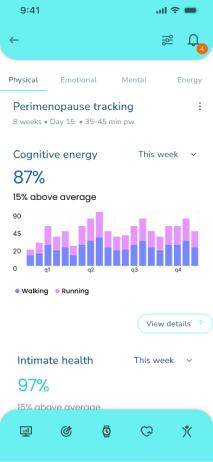
Data tracked across the four pillars via Movement.so — fed directly into the AI training pipeline.


Solution
The design shift was fundamental: from showing users data to making decisions for them. The Smart Mentor concept — a calm, adaptive guide that surfaces 1–2 personalised actions daily — replaced the dashboard model entirely. No scores to interpret. No guilt loops. Just: "Here's one thing to do right now, and here's why."
Design system, motion language, and fundraising product narrative
End-to-end UX flows from onboarding to daily adaptive actions
JITAI interaction model — right nudge, right moment, right reason
Core product strategy and MVP scope (cortisol-first, expandable later)
COLOUR SYSTEM


Soft teal gradients, calm motion cues, Inter typography — an interface that feels like a breath of air, not a clinical report.
Impact
TAM ×10
Market size unlocked by the pivot from niche to broad metabolic stress
83%
Willing to pay — strong signal ahead of any marketing spend
37.5%
Cohort conversion — unsolicited, from a 40-person research group
Gave founders a crisp investor narrative: AiTuki as the decision layer on top of wearables, not another data tracker.
Users described feeling "guided, not judged" — the core design intent, validated in their own words.
bottom of page